Το καλάθι σου είναι άδειο.
Συνολικά: 2459
/
2460
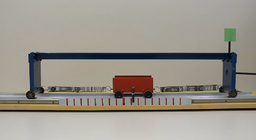
The conditions of resonance and resonance catastrophe

Oscillation of a toy on a spring damped by friction
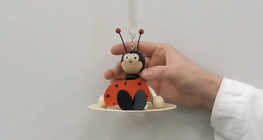
Oscillation of a toy on a spring damped by air-drag
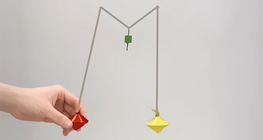

The woodpecker starts to move periodically back and forth and in the meantime it moves slowly downwards the pole

Illustrating the concept of average speed using the position-time and speed-time graphs
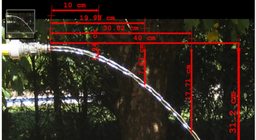
Representing horizontal projection as a complex motion
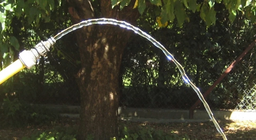
Investigating oblique projection in a Cartesian coordinate system with oblique axes.

Investigating oblique projection in a Cartesian coordinate system with oblique axes.

Introducing new quantities of simple harmonic oscillation through the position-time and velocity-time graphs

Introducing the mathematical formulas for position and velocity. Comparing the motion of the pendulum to the motion of an object on a spring

Showing through experiment that the period does not dependent on amplitude

Showing through experiment that the period of a pendulum is not dependent on mass

Demonstrating how period is effected by the pendulum length

Demonstrating how period is effected by the pendulum length. Learning and verifying the mathematical formula too.
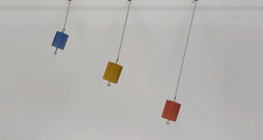
Determining free-fall acceleration by measuring the periods of pendulums
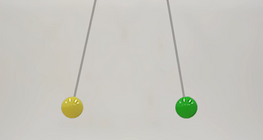
Damping of the pendulum is caused by air-drag. Air-drag depends on the shape, size and square of velocity of a moving object.

Compare the amount by which the amplitude changes at the beginning and at the end of the motion
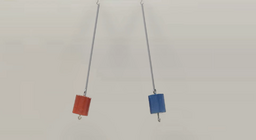
Investigating the amplitudes in a coupled oscillation

Investigating the motion of the cyclist using its position-time and velocity-time graphs

Determining speed using the position-time graph
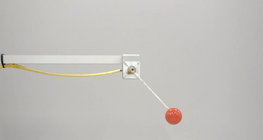
Investigating the horizontal and vertical projection of a uniform circular motion
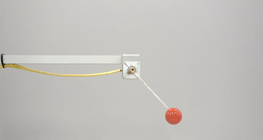
Investigating the horizontal and vertical projection of a uniform circular motion
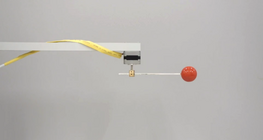
Showing the relationship of the uniform circular motion with simple harmonic motion